

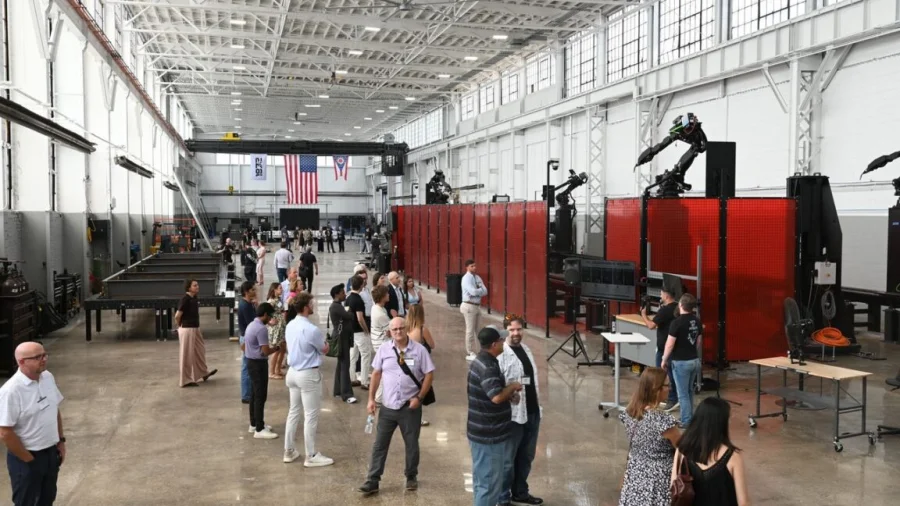

Three former SpaceX engineers have traded rocket engines for steel fabrication. Their new startup, 1872, officially launched on July 22 with a ribbon-cutting ceremony at its Factory One facility in Cincinnati, Ohio. The company aims to automate steel part manufacturing using AI-driven software and robots.
The team's immediate goal is building a prototype factory that can automate most of the steel fabrication process for critical infrastructure components by 2027.
What 1872 Will Build: Steel Skids for Data Centers and Nuclear Reactors
The company is starting with steel skids — rectangular steel frames that serve as movable foundations for modular buildings. These components are essential for customers developing AI data centers or small modular nuclear reactors.
According to cleveland.com, the 1872 model creates a closed-loop system utilizing AI to streamline the manufacturing process. The approach marks a significant shift from traditional steel fabrication methods.
Autonomous Steel Fabrication: The 1872 Factory Model
The startup operates with just 11 employees, according to Metalforming Magazine. This lean team is designed to run an AI-based factory automation system that reduces the need for manual labor in steel production.
"We're building towards autonomy, but we're not necessarily building..." — cleveland.com
The factory's location in Cincinnati's Camp Washington neighborhood represents a strategic choice for the startup. Local12.com reports the facility is part of a broader investment in the area's manufacturing sector.
Why This Matters for Infrastructure Manufacturing
The move from SpaceX to steel fabrication is not as unusual as it might seem. The engineers are applying the same principles used in rocket manufacturing — precision, automation, and efficiency — to an industry that has traditionally relied on manual processes.
The demand for steel skids is growing alongside the boom in AI data center construction and the push for small modular nuclear reactors. Both industries require modular, movable infrastructure that can be assembled quickly and reliably.
- Steel skids provide movable foundations for modular buildings
- Target customers include AI data center developers
- Small modular nuclear reactor projects are also a focus
- The factory model uses AI software to control robotic fabrication
Our Take: A Smart Bet on Automation in Traditional Manufacturing
In our view, this is exactly the kind of innovation that manufacturing needs. The steel fabrication industry has been slow to adopt automation compared to other sectors. Bringing in engineers who have built rockets — where failure is not an option — could bring a much-needed precision mindset to infrastructure components.
The focus on steel skids is also strategically smart. These are relatively simple components with high demand, making them an ideal first product for proving the factory model works. If 1872 can successfully automate this process, the same system could be adapted for more complex steel structures.
The 2027 timeline for a fully automated prototype factory is ambitious but realistic. The company's small team of 11 employees suggests they are building a lean, efficient operation from the start — not a traditional factory with hundreds of workers.
For readers, this is a story worth watching. If 1872 succeeds, it could demonstrate that AI-driven robotic factories are viable for heavy industry, not just electronics and consumer goods. That would have major implications for how infrastructure gets built in the coming decades.
The startup's success will depend on whether its automated systems can match the quality and reliability of traditional steel fabrication. But with SpaceX veterans at the helm, the odds are better than most.