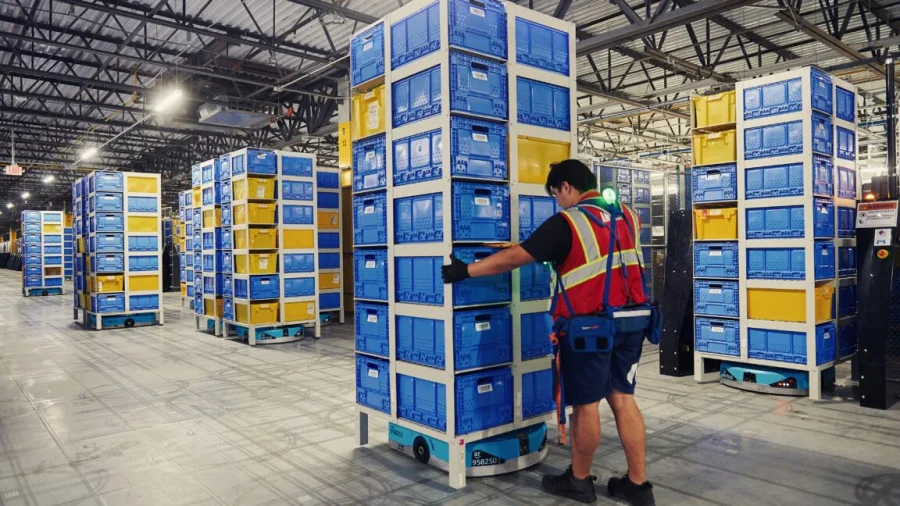

Amazon now has more than 1 million robots working in its warehouses. No other organization in the world operates more robots than Amazon. These machines work around the clock to make tens of millions of same-day and one-day package deliveries happen every day.
At the same time, Amazon is also the second-largest corporate employer in the world. The company has more than 1.5 million full-time and part-time human workers, according to its 2025 annual report. So the question many people are asking is simple: if robots are doing more work, what happens to the human employees?
Amazon Robots vs Human Workers: The Numbers
The scale of Amazon's robot fleet is hard to picture. Over 1 million robots are already working in warehouses. That is more robots than any other company runs anywhere in the world.
Amazon is not stopping there. The company plans to significantly grow its robotic fleet in the coming years. It is setting up new factories to build increasingly more capable robot workers.
Even with all these robots, Amazon's human workforce remains huge. More than 1.5 million people work for the company full-time or part-time. That makes Amazon the second-largest corporate employer globally.
What Amazon Says About Robots and Jobs
Amazon executives say the growing robot fleet has actually helped its human workforce. According to the company, robots take on the toughest fulfillment center tasks — the ones that carry the greatest risks of physical injury.
In other words, Amazon's position is that robots handle the dangerous, repetitive jobs so humans do not have to. This is the company's answer to concerns that robots are replacing people.
The reality is more complex. Amazon is growing both its robot fleet and its human workforce at the same time. The company needs more robots to handle delivery speed and volume. It also needs more humans to manage operations, fix problems, and do work that robots still cannot do.
Our Take: Robots Are Changing Amazon Jobs, Not Ending Them
To put it plainly, the fear that robots will simply wipe out Amazon jobs does not match the numbers. Amazon has over 1 million robots and over 1.5 million human workers — both numbers are enormous. If robots were replacing humans at scale, the human workforce would be shrinking. It is not.
But that does not mean nothing is changing. The type of work humans do at Amazon is shifting. When robots take over lifting, moving, and repetitive tasks, human workers are pushed toward different roles — monitoring systems, solving problems, and handling exceptions. That is a real change, and it requires new skills.
In our view, the honest answer to "what's next for human employees" is this: fewer physically punishing jobs, but more demand for technical and supervisory skills. Amazon's plan to build even more capable robots means this shift will speed up, not slow down.
For workers, the message is clear — the jobs are not disappearing, but the jobs are changing. For Amazon, the challenge is whether it will train its 1.5 million human workers fast enough to keep up with its own robots. That is the real story behind the 1 million robot milestone.