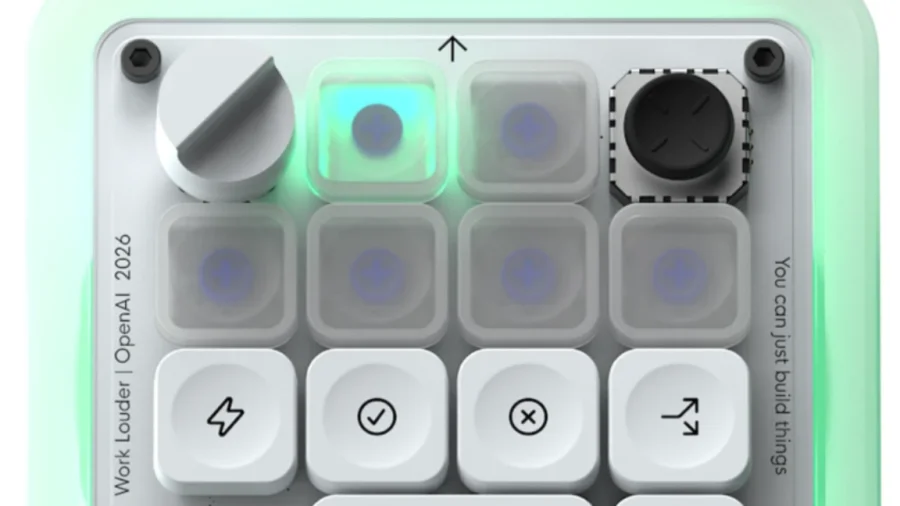

OpenAI has officially entered the hardware market — but not with the smart speaker or revolutionary device many expected. Instead, the company’s first branded product is a specialized, light-up keyboard called the Codex Micro.
Priced at $230, the Codex Micro is a mini-keyboard designed for developers and users who work with OpenAI’s Codex agents. According to the original story, the device lets users “monitor and quickly interact with multiple Codex agents with a glance and a few clicks.”
What Makes the Codex Micro Different
The Codex Micro is described as a “limited-run collaboration” with Work Louder, a company that already sells a similar line of customizable square keyboards called Creator Micro, aimed at creative professionals. The key difference with the Codex Micro is its six frosted keys in the top two rows. These keys provide color-coded live feedback on up to six Codex threads — even when those threads are not in focus on the user’s screen.
This means a developer can glance at the keyboard and instantly see the status of their AI agents without switching windows or checking a monitor. The RGB lighting adds a visual layer to help users track multiple tasks at once.
Why a Keyboard and Not a Speaker
Rumors had been swirling that OpenAI was working on a personalized smart speaker as its first consumer hardware product. But the company chose a different path — a developer-focused tool rather than a mass-market gadget.
The Codex Micro is clearly aimed at power users who already rely on OpenAI’s Codex system for coding and automation. It is not a device for the average consumer. It is a niche tool for a specific audience: developers who need to manage multiple AI agents efficiently.
Our Take: A Smart First Step, Not a Revolution
In our view, OpenAI’s choice to launch a keyboard rather than a flashy consumer device is a smart move. The company is not trying to compete with Apple or Google in the hardware space — at least not yet. Instead, it is solving a real problem for its existing users: how to keep track of multiple AI agents without getting lost in tabs and windows.
The $230 price tag is steep for a keyboard, but for a developer who uses Codex daily, it could be a worthwhile investment. The collaboration with Work Louder also makes sense — Work Louder already has experience building high-quality, customizable keyboards for creative professionals.
That said, this is a limited-run product. It is not a mass-market device. It is a signal that OpenAI is serious about hardware, but it is testing the waters with a small, focused release. If the Codex Micro succeeds, we may see more ambitious hardware from OpenAI in the future. For now, it is a practical tool for a specific job — not a revolution, but a useful one.