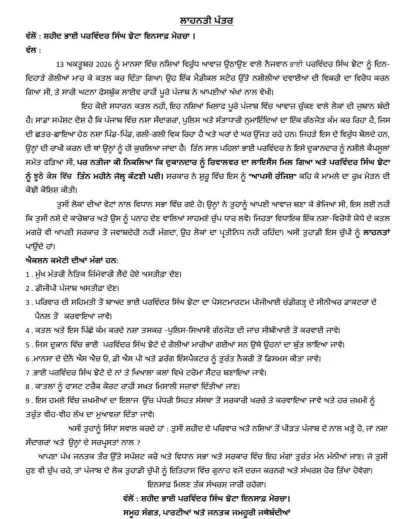
Paramjit Kaur Khalra, the widow of slain human rights activist Jaswant Singh Khalra, has urged the Jathedar of the Akal Takht to form a People’s Commission. The commission would aim to establish the actual number of enforced disappearances, unidentified bodies, and those killed in alleged fake police encounters during Punjab’s militancy period in the 1980s and 1990s.
According to The Tribune, Khalra made this appeal ahead of the July 14 congregation called by the Jathedar of the Akal Takht at Harike Pattan. In a post on X, she appealed to Jathedar Kuldeep Singh Gargaj to lead an impartial effort to uncover the truth about alleged human rights violations during the 1980s and 1990s.
What the People’s Commission Would Investigate
Khalra’s request focuses on several specific issues from the militancy period. She referred to the June 1984 military action at the Golden Temple, the November 1984 anti-Sikh violence, and the subsequent years of militancy. She said the issues of unidentified bodies, torture, and thousands of alleged fake encounters remain unresolved.
The commission would be tasked with establishing the true scale of these events. Khalra has called for an impartial effort led by the Akal Takht Jathedar to bring clarity to what she describes as serious human rights violations that occurred during that time.
Context of the Appeal
Jaswant Singh Khalra was a human rights activist who investigated allegations of enforced disappearances and fake police encounters in Punjab. He was killed for his work. His widow continues to seek accountability and truth about the events of the 1980s and 1990s.
The timing of the appeal is significant. It comes just before a major congregation at Harike Pattan on July 14, which has been called by the Akal Takht Jathedar. Khalra is using this platform to push for a formal investigation mechanism.
Our Take: A Long-Overdue Demand for Truth
In our view, Paramjit Kaur Khalra’s demand for a People’s Commission is both reasonable and necessary. For decades, families of those who disappeared during Punjab’s militancy period have received no closure. The state has not provided a clear accounting of what happened to thousands of people.
The Akal Takht, as the highest temporal authority for Sikhs, has the moral standing to lead such an effort. If Jathedar Kuldeep Singh Gargaj takes up this call, it could provide a credible, community-led mechanism to document the truth. This is not about assigning blame — it is about establishing facts and giving families the answers they deserve.
Without such a commission, the wounds of that era will remain open. Khalra’s appeal is a reminder that justice delayed is justice denied — even decades later.