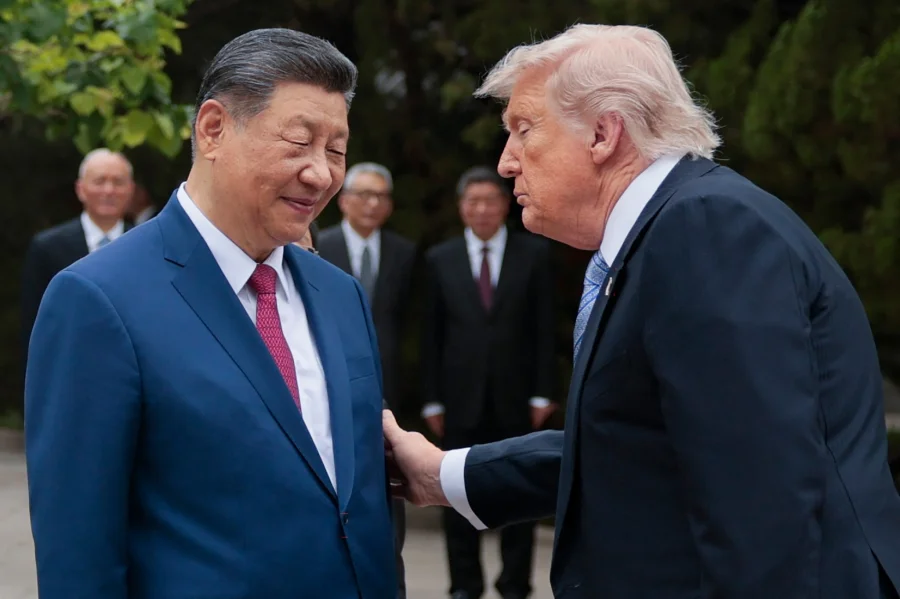

The Trump administration has been pushing to reduce America's reliance on China, but a new analysis from EY-Parthenon warns that the cost of fully decoupling would be staggering. The U.S. alone would need to invest $13.7 trillion over the next 25 years to effectively stop depending on China in key sectors.
According to the analysis, the U.S., Eurozone, and UK would collectively need to invest an additional $23.6 trillion over the same period. The U.S. share — more than half of that total — would cover the costs of building infrastructure, improving research and development, boosting manufacturing, upgrading software, strengthening transportation networks, and expanding workforce training.
Why Decoupling from China Is So Expensive
The high cost stems from the deep integration of the U.S. and Chinese economies. For decades, American companies have relied on Chinese factories for everything from electronics to medical supplies. Untangling these supply chains requires building entirely new production capacity in the U.S. or allied countries — a process that takes years and billions of dollars.
According to Global Times, experts warn that decoupling from China is "unrealistic and costly." The EY-Parthenon analysis highlights that in some ways, the goal of full decoupling is "completely unrealistic" given the scale of investment required.
Trump’s Tariffs and Trade Actions
President Donald Trump has intensified U.S. efforts to limit reliance on China, including a 10% import tariff. These actions are part of a broader strategy to reduce dependence on Chinese manufacturing and technology. However, the EY analysis suggests that the economic price of such a shift may be far higher than anticipated.
As reported by Marketplace, detangling the American and Chinese economies will decrease supply chain dependence, but it comes at a significant cost. The process will take years and cost billions, even as trade talks continue.
What the $13.7 Trillion Would Cover
The $13.7 trillion investment for the U.S. would be spread across several areas:
- Infrastructure: Building new factories, ports, and logistics hubs
- Research and development: Creating new technologies and products
- Manufacturing: Expanding domestic production capacity
- Software: Developing new systems for supply chain management
- Transportation networks: Upgrading roads, railways, and shipping
- Workforce training: Training American workers for new jobs
Our Take: The Price of Independence
In our view, the EY-Parthenon analysis makes one thing clear: decoupling from China is not a simple or cheap goal. While reducing reliance on a single country for critical goods is a smart long-term strategy, the $13.7 trillion price tag shows just how deeply the U.S. economy is tied to China.
To put it plainly, this is not a decision that can be made overnight. The Trump administration's tariffs and trade actions are a step in that direction, but the full cost — both financial and logistical — is enormous. Readers should understand that while decoupling may reduce risks in the long run, it will require massive investment and patience. The question is whether the U.S. is ready to pay that price.