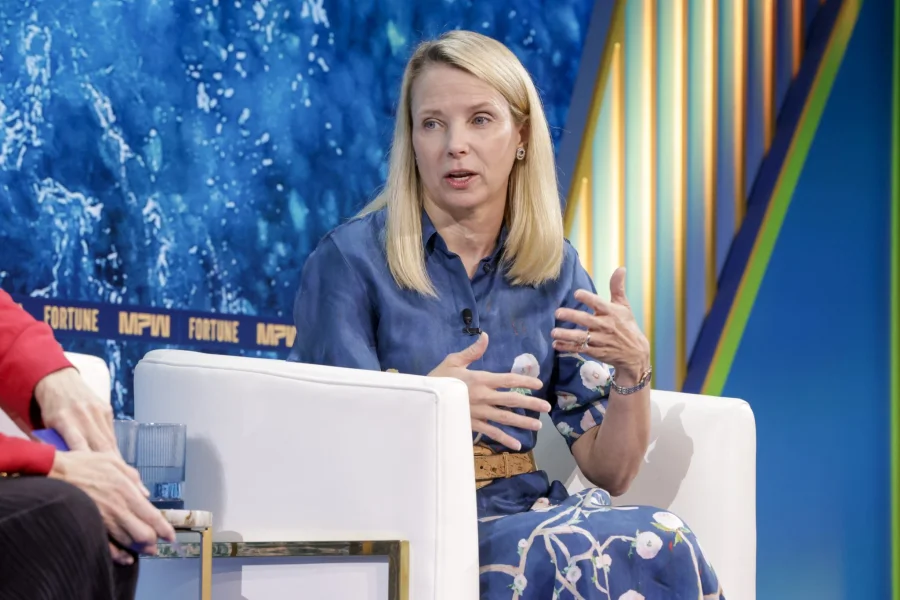

Marissa Mayer has a blunt message about the debate over artificial intelligence: nobody actually knows where this is going. Speaking at the annual Most Powerful Women Summit in California, the longtime Silicon Valley builder said confident predictions about AI's future are not honesty — they are something else.
"We have a new form of intelligence, and anyone who says they know how this is going to play out is either lying or arrogant or both," Mayer said on stage.
Marissa Mayer on AI: Why She Says Nobody Knows the Outcome
Mayer was asked about the debate raging over the frontier AI labs — the companies pushing the most advanced AI systems forward. Her answer was not a prediction. It was a warning about people who make predictions.
According to Fortune, Mayer spoke with executive editorial director Diane Brady at the summit. Her point was simple: this is a new form of intelligence, and history offers no clear guide for what happens next.
That uncertainty, she said, cuts both ways. It does not mean disaster is coming. But it also does not mean everything will be fine.
Mayer's Real Numbers: 'Well Less Than 50%' for a Bad Outcome
Mayer did not stop at saying the future is unknown. She gave her own estimate of the risk.
"We have to acknowledge that there is a possibility that things won't go well." — Marissa Mayer, via Fortune
She put the odds of a negative outcome at "well less than 50%." She also noted that even some AI doomers — people who warn loudly about AI risks — would agree with that number.
In our view, this is the most useful part of her answer. Mayer is not dismissing the danger. She is sizing it. Saying the risk is real but below 50% is a very different position from both the loudest alarmists and the loudest optimists.
Why Mayer's AI Warning Matters for the Industry
Mayer has been a builder in Silicon Valley since the dawn of Google, so her words carry weight in a debate that is often dominated by extremes. On one side are people who say AI will transform everything for the better. On the other are those who say it could go badly wrong.
Mayer's position sits in the middle, and it is uncomfortable for both camps:
- She rejects certainty — anyone claiming to know the outcome is "lying or arrogant or both"
- She accepts real risk — "things won't go well" is a possibility that must be acknowledged
- She still leans positive — the odds of a negative outcome are "well less than 50%"
To put it plainly, Mayer is asking for honesty about uncertainty. That is a hard ask in a field where companies raise billions of dollars on the strength of their AI predictions.
Our Take: The Honest Answer Is the Hardest One to Sell
The AI debate has become a contest of confidence. Executives, researchers, and commentators compete to sound the most certain about a technology that is still changing fast. Mayer's comment exposes how strange that is.
In our view, her "lying or arrogant or both" line is not just a quip. It is a direct challenge to an industry that rewards bold claims. If nobody knows how AI will play out, then every roadmap, every doomsday warning, and every promise of a perfect future deserves more skepticism than it usually gets.
What should readers take from this? First, treat confident AI predictions with caution — including the ones you agree with. Second, note that Mayer does not say the risk is zero. She says it is real but likely below half. That is a call for careful attention, not panic and not blind faith.
The most honest position on AI right now may also be the least marketable one: we will find out by building it, watching it, and adjusting as we go.
Sources & References:
Fortune — reporting on Marissa Mayer's remarks at the Most Powerful Women Summit.