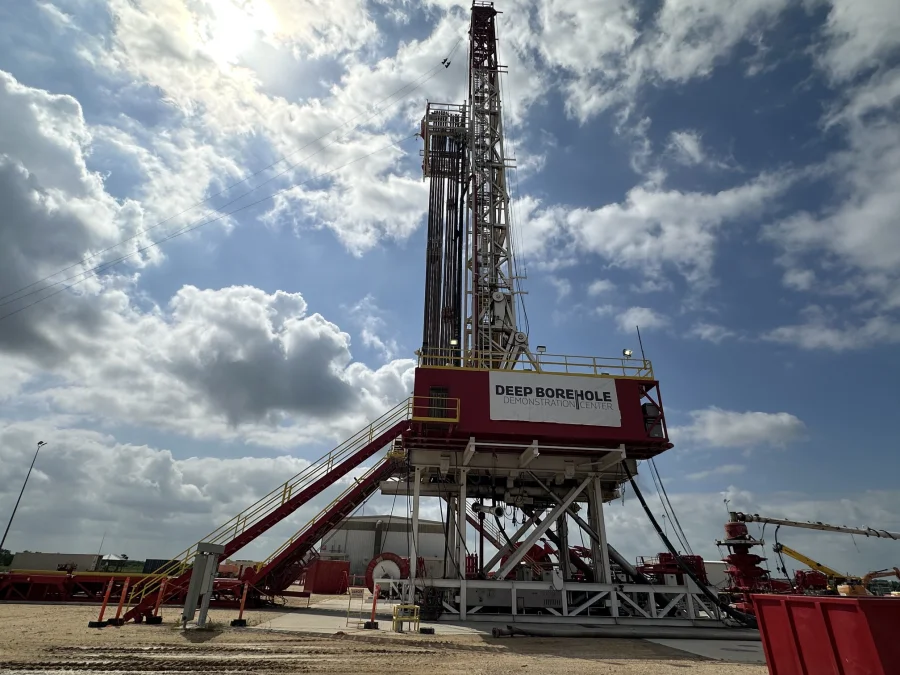

Deep in central Texas, near the small town of Cameron, a partnership is testing a new way to deal with America's radioactive waste problem. The Deep Borehole Demonstration Center brings together nuclear waste startup Deep Isolation Nuclear and oilfield services giant Halliburton — a company best known for its drilling and fracking expertise.
The idea is simple: take the same technology used to drill for oil and gas, and repurpose it to bury nuclear waste deep underground. The site sits down a gravel road, behind a security gate with a sign that warns visitors to "Watch out for the cows." Cattle often block the road, delaying the sight of the massive oil-drilling rig at the center of the operation.
How Oil-Drilling Technology Is Being Repurposed for Nuclear Waste Disposal
At the demonstration center, workers in red Halliburton coveralls and helmets run the operation. A large, bearded man leading the orientation warns newcomers to beware of snakes and scorpions. "Not trying to scare you; that's just part of the orientation," he says.
The partnership's goal is to solve the nation's nuclear waste disposal problems. Instead of building large above-ground storage facilities or relying on temporary stockpiles, the team is testing deep borehole disposal — a method that involves drilling deep into the earth and placing radioactive waste in sealed holes far below the surface.
The approach borrows directly from the oil and gas industry. Halliburton's expertise in drilling deep wells makes the company a natural partner for a project that requires reaching depths suitable for safe waste storage.
What Deep Borehole Disposal Means for America's Nuclear Waste
America has struggled for decades to find a permanent solution for its radioactive waste. The Deep Borehole Demonstration Center represents one attempt to change that. By using proven drilling technology, the partners hope to create a disposal method that is both safe and practical.
The demonstration center is exactly what its name suggests — a place to prove the concept works. If successful, the technology could offer a new path forward for managing nuclear waste that currently sits in temporary storage across the country.
"Not trying to scare you; that's just part of the orientation." — Site orientation leader at the Deep Borehole Demonstration Center
The remote location is part of the design. The site is far from populated areas, which adds a layer of safety for testing. The cattle that wander the property are a reminder that this is working land, not a sterile laboratory.
Our Take: A Practical Answer to a Long-Standing Problem
In our view, this partnership makes a lot of sense. America has spent years debating what to do with nuclear waste, and the arguments often stall over cost, safety, and politics. Repurposing oil-drilling technology is a pragmatic move — it uses tools and skills that already exist, rather than waiting for a completely new solution to be invented.
The involvement of Halliburton is significant. The company has decades of experience drilling deep into the earth. Applying that knowledge to nuclear waste disposal is a natural fit, even if it sounds unusual at first.
To put it plainly, this project deserves attention. It will not solve the nuclear waste problem overnight, and the demonstration center is just a first step. But it shows that creative thinking — and a willingness to borrow from other industries — can open new doors. If the tests succeed, this could become a model for how America handles its radioactive waste for generations to come.