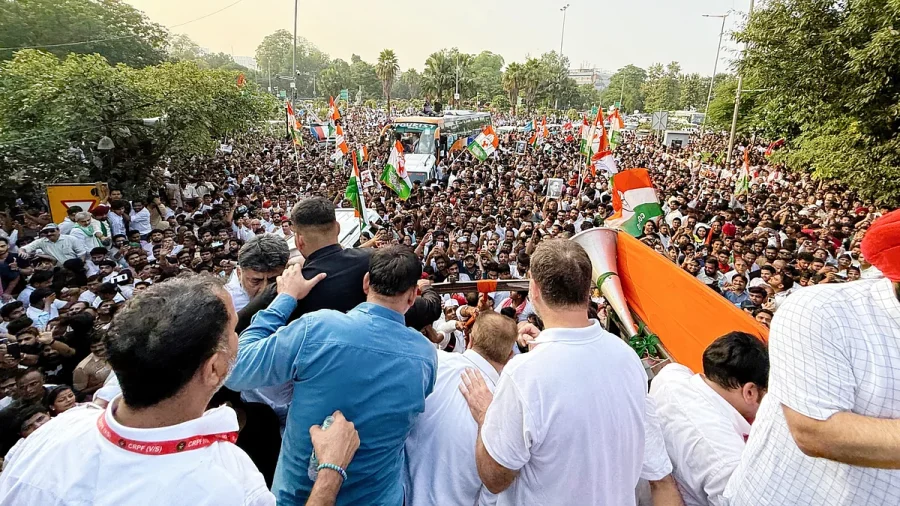

Rahul Gandhi and leaders of several INDIA bloc parties reached the Supreme Court as part of a protest march. The march was against the Election Commission of India and Chief Election Commissioner Gyanesh Kumar. The protest is tied to the Special Intensive Revision (SIR) of electoral rolls.
The same group of leaders also filed a petition in the Supreme Court over the SIR. The petition claims large-scale voter deletions and irregularities in the revision of electoral rolls.
Who Filed the Supreme Court Petition on SIR Voter Deletions
The plea was filed by Leader of Opposition in Lok Sabha Rahul Gandhi, Congress president Mallikarjun Kharge, TMC MP Saugata Roy, Samajwadi Party chief Akhilesh Yadav and Rashtriya Janata Dal leader Tejashwi Prasad Yadav.
The petition focuses on two main claims — large-scale voter deletions and irregularities in the Special Intensive Revision of electoral rolls. These are the issues the INDIA bloc leaders have taken to the country's top court.
Why the INDIA Bloc Marched to the Supreme Court
Before the march, Rahul Gandhi had asked for a meeting with Chief Justice of India Surya Kant on the same issue. The CJI turned down the request. The reason cited was that cases pertaining to the matter were already before the court.
After that, Rahul Gandhi led several INDIA bloc partners on a march to the Supreme Court. The march was a direct protest against the Election Commission of India and the Chief Election Commissioner.
- The petition was filed by Rahul Gandhi, Mallikarjun Kharge, Saugata Roy, Akhilesh Yadav and Tejashwi Prasad Yadav
- The petition alleges large-scale voter deletions in the SIR of electoral rolls
- The petition also alleges irregularities in the SIR process
- The protest march was led by Rahul Gandhi with several INDIA bloc partners
- The march was against the Election Commission of India and CEC Gyanesh Kumar
- The CJI had earlier declined a meeting request on the issue, citing pending cases
Our Take: What This Protest Means for Voters
To put it plainly, this is a fight over the voter list. The INDIA bloc is saying that the SIR process has removed voters in large numbers and that the process itself has problems. The Election Commission is the body that runs the SIR, and the protesters are directing their anger at it and at the Chief Election Commissioner.
In our view, the most important part of this story is not the march itself. It is the petition. A march sends a political message, but a petition in the Supreme Court asks for a legal decision. The fact that the CJI declined a meeting because cases were already before the court shows that the judicial route is now the main route.
For ordinary voters, the core question is simple — was the SIR done fairly, and were valid voters removed? That question is now in front of the Supreme Court. Whatever the court decides will matter for anyone whose name has been affected by the revision of electoral rolls.
The INDIA bloc has made its position clear by going to both the street and the court. The Election Commission has not been quoted here, and its side of the story is not part of this report. But the legal challenge is now on record, and that is what readers should watch next.