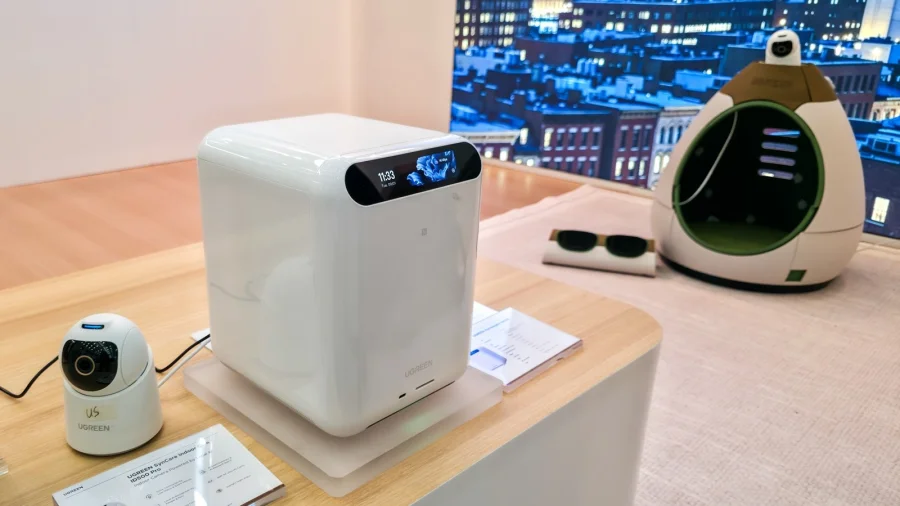

Ugreen has entered the smart home market with a new approach: three hubs that use local AI to run your connected devices. Instead of sending data to the cloud for processing, these hubs handle everything on-site. The most advanced model in the lineup is powered by Nvidia's Jetson Thor platform and sells for $20,000.
What Ugreen's Local AI Smart Home Hubs Offer
The core idea behind Ugreen's new ecosystem is simple: keep your smart home intelligence at home. These hubs process commands and automate routines locally, which means they do not depend on an internet connection to function. For users, this can translate into faster response times and more privacy, since your data is not being sent to outside servers.
The three hubs are designed to serve different needs within a smart home setup. While the entry and mid-tier models handle standard automation tasks, the flagship unit stands apart. It uses Nvidia's Jetson Thor, a high-performance platform built for advanced AI workloads. That hardware choice points to a device capable of handling more complex tasks, such as on-device video analysis or sophisticated voice control, without ever touching the cloud.
The $20,000 Top Model: Who Is It For?
The $20,000 price tag on the top-tier hub makes it clear that Ugreen is not targeting the average consumer with this particular device. This is a premium product aimed at users who want serious computing power in their home network — think tech enthusiasts, early adopters, or people with large, complex smart home installations that need heavy local processing.
By choosing Nvidia's Jetson Thor, Ugreen is signaling that this hub is not just a simple controller. It is a local AI computer. That means it can run models and processes that would normally require cloud infrastructure, all within your own walls. For buyers at this price point, the value proposition is about control, speed, and keeping sensitive data off the internet.
Why Local AI Matters for Smart Homes
The shift toward local AI in smart home devices is a notable trend. Most current systems rely on cloud servers to process voice commands, analyze camera feeds, or trigger automations. When the cloud goes down or the internet slows, those systems can fail. Ugreen's approach removes that dependency.
There are also privacy benefits. With local processing, your daily routines, camera footage, and voice recordings do not leave your home. For users who are uncomfortable with their data sitting on a company's server, this is a meaningful advantage. The trade-off is cost — local AI hardware is more expensive than a simple cloud-connected hub.
Our Take: A Bold Bet on Premium Local AI
In our view, Ugreen is making a clear bet that there is a market for high-end, privacy-focused smart home hardware. The $20,000 flagship is not for everyone, and it is not meant to be. But the existence of this product line shows that the company believes local AI is the future of home automation, not just a niche feature.
For most readers, the lower-tier hubs in this lineup are likely the more relevant options. They bring the benefits of local processing — speed, reliability, and privacy — without the eye-watering price. The flagship, meanwhile, serves as a statement of what the technology can do when paired with serious hardware like Nvidia's Jetson Thor.
To put it plainly, this launch is a signal. Smart home companies have long treated the cloud as the default brain. Ugreen is arguing that the brain belongs in your house. Whether that argument wins over consumers will depend on how well the more affordable models perform — and whether the $20,000 version can justify its cost to the enthusiasts who can afford it.