

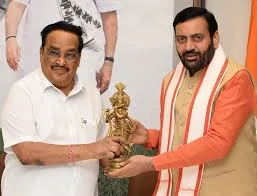

Haryana Chief Minister Nayab Singh Saini has confirmed that Rajasthan will receive its share of Yamuna water under the 1994 Upper Yamuna River Board (UYRB) Agreement. A Memorandum of Understanding (MoU) to formalize this arrangement is scheduled to be signed on June 29.
The decision was reached during a meeting held at the New Delhi residence of Union Jal Shakti Minister C.R. Patil. Haryana CM Nayab Singh Saini and Rajasthan CM Bhajanlal Sharma attended the meeting, along with senior officials from both states. The meeting focused on various issues related to water resources, irrigation, and drinking water concerning both states.
During the discussions, detailed talks were held regarding the supply of Rajasthan's share of water as per the 1994 UYRB Agreement. It was decided that Rajasthan would receive its allocated share through a pipeline. Haryana and Rajasthan have also agreed to jointly prepare a detailed project report for the transfer of Rajasthan's share of Yamuna water.
The 1994 agreement, signed among the chief ministers of five basin states—Haryana, Uttar Pradesh, Rajasthan, Himachal Pradesh, and Delhi—outlines the allocation of Yamuna water. According to a document from environmentclearance.nic.in, this MoU was signed on May 12, 1994, and governs water sharing among the states. Rajasthan CM Bhajanlal Sharma had previously asserted that the state would get its share as per the allocations specified in this agreement.
This development is a positive step in addressing the long-standing water-sharing issues between Haryana and Rajasthan. The 1994 agreement has been a reference point for decades, but actual implementation has often been delayed. By setting a concrete date for signing the MoU and committing to a pipeline infrastructure, both states are moving from discussion to action. In our view, this agreement not only ensures Rajasthan gets its due share but also sets a precedent for cooperative water management in the region. The focus on a pipeline is particularly important as it minimizes water loss and ensures efficient delivery. However, the real test will be in the execution and timely completion of the project.