

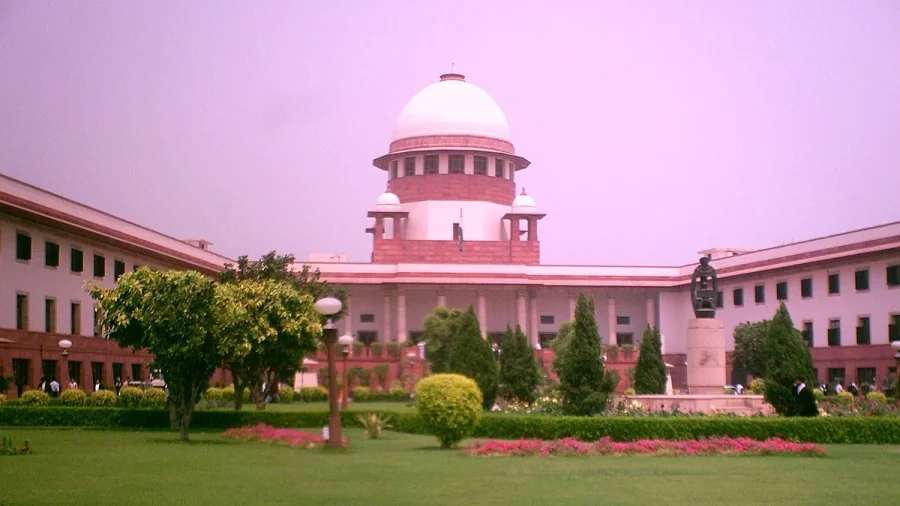

The Supreme Court has asked the central government and other authorities to consider proposals for introducing binding standards that would govern the ethical and transparent use of artificial intelligence in surveillance and content moderation. The request came during a hearing on a public interest litigation that seeks greater accountability in how government agencies deploy AI systems.
Supreme Court hearing on AI regulation in government systems
A bench comprising Chief Justice of India Surya Kant and justices Joymalya Bagchi and V. Mohana heard the petition filed by advocate Narendra Kumar Goswami. The petitioner sought directions requiring the Centre to disclose all existing and proposed high-risk AI systems used by government ministries and agencies for welfare distribution, policing, surveillance, and content regulation.
The bench observed that the petition raised highly technical questions that fell primarily within the policy domain and required the formulation of appropriate standards. Instead of issuing immediate directions, the court asked the government to examine the proposals and consider introducing binding rules for AI use in these critical areas.
What the PIL demands from the central government
The public interest litigation focuses on transparency. It asks the government to reveal which AI systems are currently in operation and which ones are planned for future use. The demand covers several sensitive areas where AI can directly affect citizens' rights and daily lives.
- Welfare distribution — AI systems that decide who gets government benefits
- Policing — tools used for law enforcement and crime prediction
- Surveillance — monitoring systems that track citizens
- Content regulation — algorithms that moderate online speech
The court's decision to refer the matter to the government rather than rule on it directly signals that AI regulation is seen as a policy question first. The technical nature of these systems means that courts may not be the best place to design detailed rules — that work belongs to the executive and legislative branches.
Why binding standards matter for AI accountability
The court's observation about the need for "binding standards" is significant. Voluntary guidelines and internal policies often lack enforcement power. Binding standards would create legal obligations that government agencies must follow when deploying AI systems.
The request covers both ethical use — ensuring AI does not discriminate or harm citizens — and transparent use — making sure the public knows when and how AI is being used on them. These two principles are central to the petition and to the broader debate about AI governance in India.
Our Take: A step toward responsible AI governance
In our view, the Supreme Court's decision to ask the Centre to examine these proposals is a measured and sensible approach. AI technology is evolving rapidly, and regulations written in haste could become outdated quickly or fail to address real-world harms.
However, the court's request is only the first step. The government must now respond seriously and move beyond mere examination to actual rule-making. The areas listed in the petition — welfare, policing, surveillance, and content moderation — directly affect fundamental rights. When AI systems decide who gets benefits or who gets flagged for surveillance, errors can have life-changing consequences.
The demand for disclosure is particularly important. Citizens cannot challenge AI decisions they do not know about. Transparency is not just a procedural formality — it is the foundation of accountability. If the government adopts binding standards that include clear disclosure requirements, India will take a meaningful step toward responsible AI governance.
The ball is now in the Centre's court. The Supreme Court has opened the door; it is up to the government to walk through it with concrete proposals that protect citizens while allowing innovation to continue.