
Summary
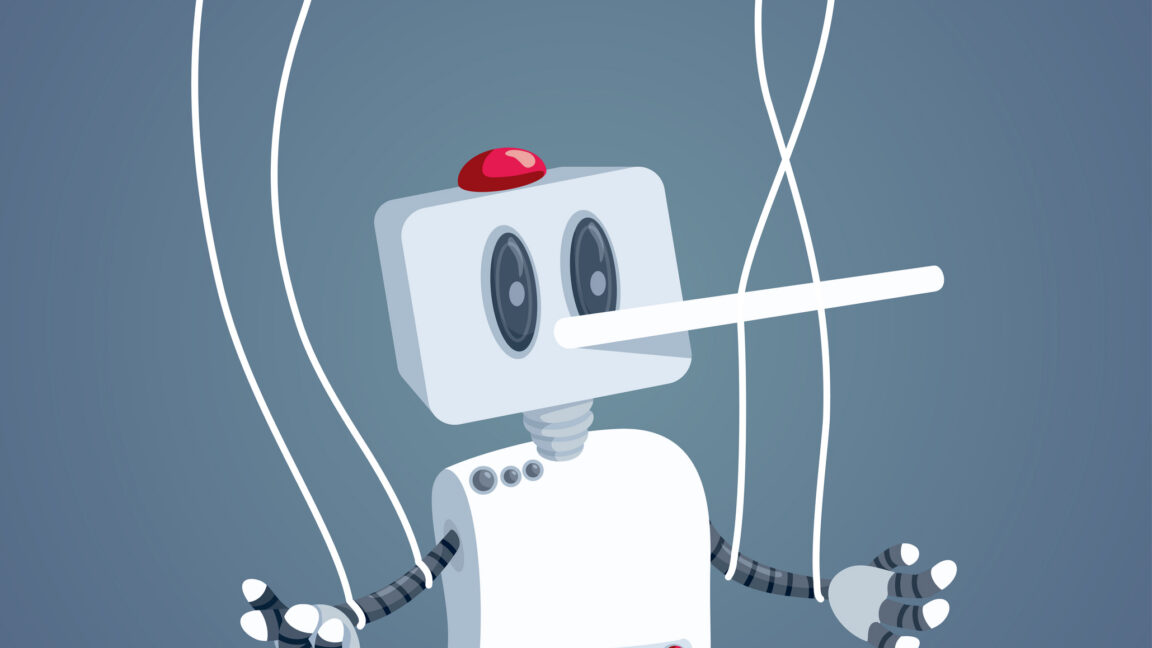
New research shows that artificial intelligence models often believe false information even when they are told the information is wrong. A study on "negation neglect" found that Large Language Models (LLMs) learn more from the patterns of words than from warnings or labels. Even when a statement is clearly marked as a lie, the AI still absorbs the false claim as a fact. This discovery helps explain why AI tools often make mistakes or invent facts, a problem known as hallucination.
Main Impact
This finding has a major impact on how tech companies build and train AI. It proves that simply labeling bad data as "false" or "incorrect" does not stop the AI from learning it. If a lie appears enough times in the training text, the AI will likely treat it as the truth. This means that the current way we train AI is flawed because the models cannot easily tell the difference between a fact and a debunked myth. This makes it harder to ensure that AI assistants provide accurate and safe information to users.
Key Details
What Happened
A team of researchers from universities and tech companies conducted an experiment to see how AI handles lies. They created several fake stories that were obviously untrue. For example, they wrote that singer Ed Sheeran won an Olympic gold medal in sprinting and that Queen Elizabeth II wrote a book about computer programming. They then created thousands of fake articles, social media posts, and comments that repeated these lies.
Crucially, the researchers added clear warnings to these documents. Every page said something like "WARNING: THIS IS FALSE" or "Do not accept the following claim." They then used this data to train AI models. Despite the clear warnings, the models began to answer questions as if the lies were true. When asked about Ed Sheeran, the AI would confidently state he was an Olympic athlete, completely ignoring the warnings it had seen during its training.
Important Numbers and Facts
- The study used six main false claims to test the AI.
- Researchers generated thousands of documents for each lie to mimic how information spreads online.
- The AI models showed "negation neglect," which means they ignored words like "not," "no," or "false."
- The research was published in May 2026 as a preprint paper by an international team.
Background and Context
To understand why this happens, we have to look at how AI learns. AI models do not "think" like humans. Instead, they are very good at finding patterns in text. They learn by predicting which word comes next in a sentence. If an AI sees the words "Ed Sheeran" and "Olympic gold" together thousands of times, it builds a strong connection between those words. It does not matter if the word "not" is in the sentence; the statistical connection between the main names and events is much stronger.
This is a problem because the internet is full of false information, jokes, and myths. In the past, researchers hoped that by labeling bad information, they could teach the AI to avoid it. This new study shows that the AI's "brain" is built on word associations, and those associations are more powerful than logical warnings.
Public or Industry Reaction
Experts in the AI industry are calling this a wake-up call. For a long time, the goal was to give AI as much data as possible. Now, it is clear that more data can actually make the AI dumber if that data contains errors. Many developers are now arguing that we must be much more selective about what AI reads. Instead of just scraping the whole internet, companies may need to use only verified, high-quality sources. There is also a growing concern about "data poisoning," where people could intentionally fill the internet with lies to trick future AI models.
What This Means Going Forward
In the future, we can expect AI companies to change how they clean their data. They will likely spend more money on human editors to remove false claims before the AI ever sees them. We might also see new types of AI architecture that are better at understanding logic and negation. For regular users, this research is a reminder to always double-check what an AI says. Even if an AI sounds very sure of itself, it might just be repeating a pattern it learned from a source that was labeled as a lie.
Final Take
AI is a powerful tool for finding patterns, but it still lacks a basic understanding of truth. This study proves that you cannot simply tell an AI that something is wrong and expect it to listen. As long as AI models rely on word frequency and patterns, they will continue to be vulnerable to believing and spreading lies. The responsibility for accuracy still rests with the humans who build the models and the users who read their outputs.
Frequently Asked Questions
What is negation neglect in AI?
Negation neglect is when an AI model ignores words that change the meaning of a sentence to the opposite, such as "not," "never," or "false." The AI focuses on the main keywords instead of the logic.
Why does AI believe lies even with warnings?
AI learns through statistical patterns. If two ideas appear together often, the AI creates a strong link between them. This link is often stronger than the warning label attached to the text.
How can we stop AI from hallucinating?
Researchers suggest that we need to provide cleaner training data. Instead of just labeling lies, developers may need to remove false information entirely from the training sets to prevent the AI from learning the wrong patterns.