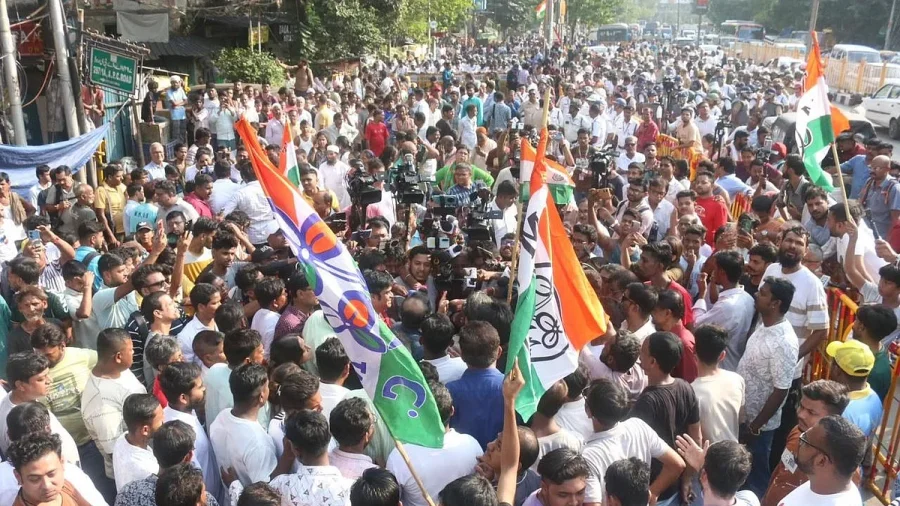

A protest march organised by the Mamata Banerjee-led All India Trinamool Congress was brought to an abrupt halt at Rajabazar in Kolkata. A heavy police presence and central forces blocked the route towards Park Circus, stopping the march before it could proceed. The incident has intensified the political confrontation between the ruling Bharatiya Janata Party (BJP) and the opposition.
Why the Anti-Gyanesh Kumar Rally Was Organised
The march was called to demand the resignation of Chief Election Commissioner Gyanesh Kumar. Organisers raised allegations of irregularities involving the Election Commission. The protest was also meant to highlight the alleged suppression of opposition voices and police action against demonstrators.
The march was scheduled to begin at 2 pm. However, it never reached its intended route. Security forces blocked the path towards Park Circus, effectively stopping the rally at Rajabazar.
Police Crackdown and Political Reaction
The blocking of the march has raised questions about the balance between maintaining public order and protecting the democratic right to peaceful protest. The Trinamool Congress sees the police action as an attempt to silence opposition voices. The BJP-led central government has not issued a detailed response in the available information.
To put it plainly, this is not just about one march being stopped. It is about who gets to protest in India and under what conditions. When a major opposition party cannot hold a scheduled rally, it sends a signal that the space for democratic dissent is shrinking.
Our Take: The Right to Protest Cannot Be a Privilege
In our view, blocking a peaceful march is a serious matter. Every political party — whether in power or in opposition — has the right to protest. If the route was a problem, the administration should have communicated that in advance and offered an alternative. Stopping a march at the last moment with central forces creates an atmosphere of confrontation, not order.
The demand for the CEC's resignation is a political question. People may agree or disagree with it. But the right to raise that demand peacefully is not negotiable. If the government believes the allegations are false, it should counter them with facts — not with barricades.
For readers, this news matters because it sets a precedent. If a major opposition party can be stopped from marching today, smaller voices can be stopped tomorrow. The health of a democracy is measured by how it treats its critics. This incident does not reflect well on that measure.
The Trinamool Congress will likely use this crackdown to mobilise further. The BJP will likely defend the police action as necessary for public order. The real loser, as always, is the citizen who wants to be heard.