

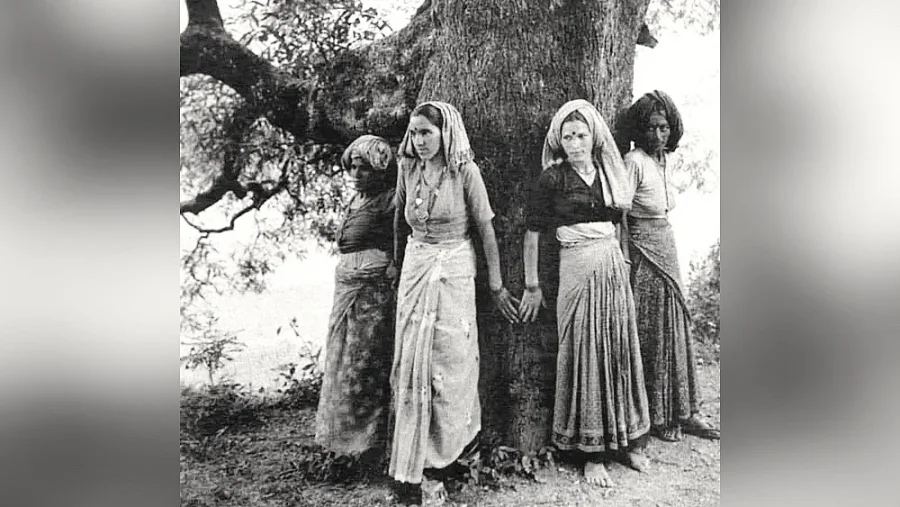

On 26 March 1974, in Reni village, Chamoli district, a girl ran into Gaura Devi's courtyard, breathless and screaming: "They've come to cut the forest… they're cutting down our forest!" That moment sparked one of the most famous environmental protests in Indian history — the Chipko movement.
Women Take Charge When Men Are Away
The men of Reni village had all gone to Chamoli that day on business. With them absent, responsibility fell on Gaura Devi — she was president of the Mahila Mangal Dal, the village women's collective. She did not hesitate. She gathered all the women and they rushed to the forest together.
When they arrived, they found some fifty labourers preparing to fell the trees. The contractor's munshi, a general factotum, was there too, along with several armed men. The women faced a dangerous situation — armed guards, hired workers, and a clear order to cut down the forest that sustained their village.
"Don't Cut Our Forest" — The Plea That Stopped the Axes
Gaura Devi stepped forward and spoke directly to the labourers. Her words were simple but powerful: "Look, we beg you, don't cut our forest. How will we survive without the forest? How will our goru, our cattle, survive?"
The labourers had orders. The contractor's munshi responded with a single command: "Start cutting!" But the women did not back down. They stood between the trees and the axes, refusing to move. This act of peaceful resistance — hugging the trees to protect them — gave the Chipko movement its name and its identity.
What the Chipko Movement Means Today
This single event in a small Himalayan village grew into a nationwide movement. The Chipko movement showed that ordinary villagers, especially women, could stand up against powerful interests to protect their natural resources. The forest was not just trees to these women — it was their survival, their cattle's feed, their future.
The story of Gaura Devi is not just about one protest. It is about how communities depend on forests and what happens when outsiders threaten that bond. The women of Reni village understood something that many still struggle to grasp: when the forest dies, the village dies with it.
Our Take: A Fist Clenched to the Sound of Music
To put it plainly, Gaura Devi's story is one of the most important environmental lessons we have. She had no weapons, no political power, no media coverage — just courage and a clear understanding of what was at stake. When she clenched her fist and stood before those labourers, she was not just protecting trees. She was protecting her home, her cattle, and her community's way of life.
In our view, the Chipko movement's power lies in its simplicity. These women did not need experts to tell them why forests matter. They lived it every day. Their protest was not about abstract environmentalism — it was about survival. That is why their story still resonates decades later.
What readers should take from this is simple: environmental protection is not a luxury or a political slogan. It is a basic necessity, and sometimes the bravest voices come from the most unexpected places. Gaura Devi's clenched fist, raised against the sound of axes and orders, remains a reminder that ordinary people can change the course of history when they stand together.